

Homs Old Markets Restoration




Project Scope and Timeline
On 13 May 2026, Samer Sabreen, Secretary of the Homs Heritage Markets Committee, announced that the second phase of restoring and rehabilitating the old Homs markets would begin within 15 days and be completed within two months, after which the markets would reopen to the public, according to Syria TV citing Al-Ouruba newspaper. The phase is part of a project whose total cost was put at about 11 billion Syrian pounds.
According to Sabreen, the project covers 14 markets in addition to Khan al-Qaysariyya, which SANA (August 2025) counts among the surviving landmarks of the Mamluk era and which once served as a meeting point for trade caravans from across the country.
Before the Second Phase
The first phase of the current project to restore the Homs heritage markets began in August 2024 and continued through 2025, completing the restoration of roofs and stone arches alongside the rehabilitation of service infrastructure, according to an Anadolu Agency report published in July 2026.
In August 2025, Director of City Beautification Inas Bayqali, who supervises the Heritage Markets Development Committee, told SANA that the revival of the markets had followed two tracks: a civil track restoring roofs and stone arches, and an electrical track lighting the market and its branches. According to the figures she gave, the markets contain 981 heritage-listed shops and 1,200 non-listed shops, of which 475 heritage shops and 1,020 non-listed shops had resumed trading by then. The return of shops is therefore partial and gradual, and began before the second phase. She also pointed to the formation of a new committee linking merchants with Homs City Council, along with guard rooms, protection posts, decorative lighting and a dedicated fund for maintaining the markets.
Rehabilitation Works
According to Sabreen (May 2026), the project's rehabilitation works, including in Souq al-Sagha, have covered:
- Restoration of roofs, stone facades and arches
- Rehabilitation of infrastructure
- A complete lighting system inside the markets
- Satellite and regular internet services and telephone lines
- Completion of electrical supply works and maintenance of gutters and roofs
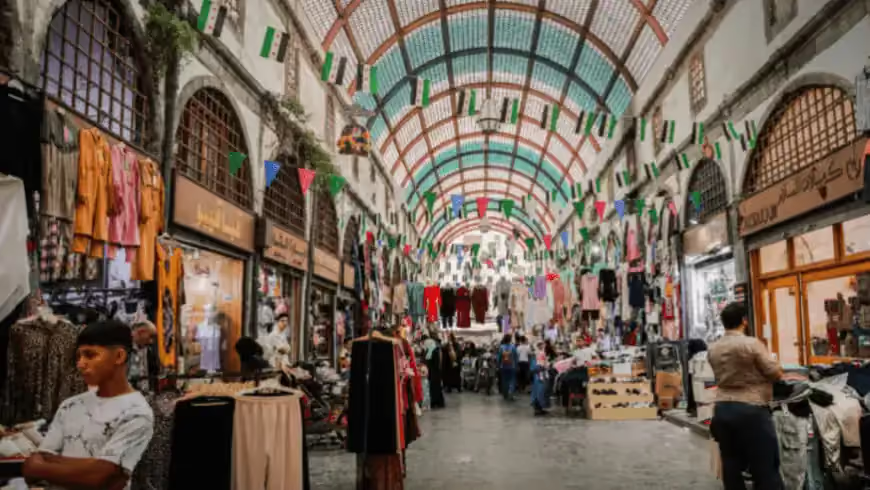
Sabreen pointed to improvements to some roofs, where corrugated zinc sheets were replaced with colored fiberglass panels that distribute light better without compromising the markets' heritage character. Souq al-Sagha kept its traditional gabled roof (jamalun), which was covered with fiberglass panels that let in natural light.
Protection of Archaeological Sites
According to Sabreen, the project goes beyond improving appearances to safeguarding the archaeological sites inside the markets, among them the small Ottoman bathhouse in Souq al-Sagha, the two-storey al-Maasarani passage and the Silver Market passage, landmarks that give the old markets added historical and architectural value.
Implementation and Funding
According to Sabreen, the restoration was carried out in partnership between the Syrian Development Organization and the Homs Chambers of Commerce and Industry, backed by donations from merchants and industrialists. The Syria TV report presented this arrangement as an example of public-private cooperation in preserving heritage and supporting local development.
Challenges
Sabreen listed difficulties the project faced, chiefly a scarcity of the raw materials needed for restoration, limited financial resources that slowed some works, few workshops able to work the old black stone used to restore the arches, and too few specialised craftsmen to finish the floor paving.
Frequently Asked Questions
What is the total cost of the project?
When the second phase was announced on 13 May 2026, the total cost of the restoration project, within which the phase is carried out, was put at approximately 11 billion Syrian pounds.
When is the second phase due to be completed?
On 13 May 2026, Sabreen said work would start within 15 days and be completed within two months. An Anadolu Agency report published on 18 July 2026 quoted Homs Deputy Governor Fares al-Atassi as saying in June that final restoration works were under way in the covered market and that efforts were continuing across the 14 markets.
Have the markets reopened?
Partially and gradually. By August 2025, 475 of 981 heritage shops and 1,020 of 1,200 non-listed shops had resumed trading, according to SANA. In July 2026, Anadolu Agency reported that large parts of the Ottoman covered market had reopened, and Al Jazeera Net reported traders gradually returning to their shops.
How many markets does the project cover?
14 markets in addition to Khan al-Qaysariyya, one of the surviving landmarks of the Mamluk era.
Who is carrying out the restoration works?
According to Sabreen, the works are a partnership between the Syrian Development Organization and the Homs Chambers of Commerce and Industry, relying on donations from merchants and industrialists. The Anadolu Agency report of 18 July 2026 quoted Homs Deputy Governor Fares al-Atassi as saying in June that the organisation was carrying out the works, funded by donations from organisations, merchants and industrialists from Homs.
Update — 2026-07-21
The restoration has begun to show results on the ground. In a video report published by Al Jazeera Net on 21 July 2026, the Ottoman covered market in Homs was shown gradually regaining its commercial role as traders return to their shops and traditional crafts such as copperwork, blacksmithing, textiles and clothing revive.
In an Anadolu Agency report carried by the Syrian news site Aksalser on 18 July 2026, large parts of the covered market had reopened after restoration and rehabilitation, and crafts including copperwork, blacksmithing, textiles, silk and spinning had resumed there. The report quoted Homs Deputy Governor Fares al-Atassi as telling Syria TV in June that the market was seeing final restoration works by the Syrian Development Organization, funded by donations from organisations, merchants and industrialists from Homs, and that work was continuing to restore 14 markets with about one thousand heritage shops.

SANA: Homs old markets, a living architectural heritage and economic hub, 21 August 2025
Syria Today: Homs old markets, restoring the city's economic memory, 14 May 2026
Anadolu Agency via Aksalser: Homs Ottoman covered market regains its pulse, 18 July 2026
Al Jazeera Net: Gradual revival of the Ottoman covered market in Homs (video), 21 July 2026