.avif)

Metro of Damascus (Green Line)
.avif)
.svg)

.avif)
.svg)
Project overview
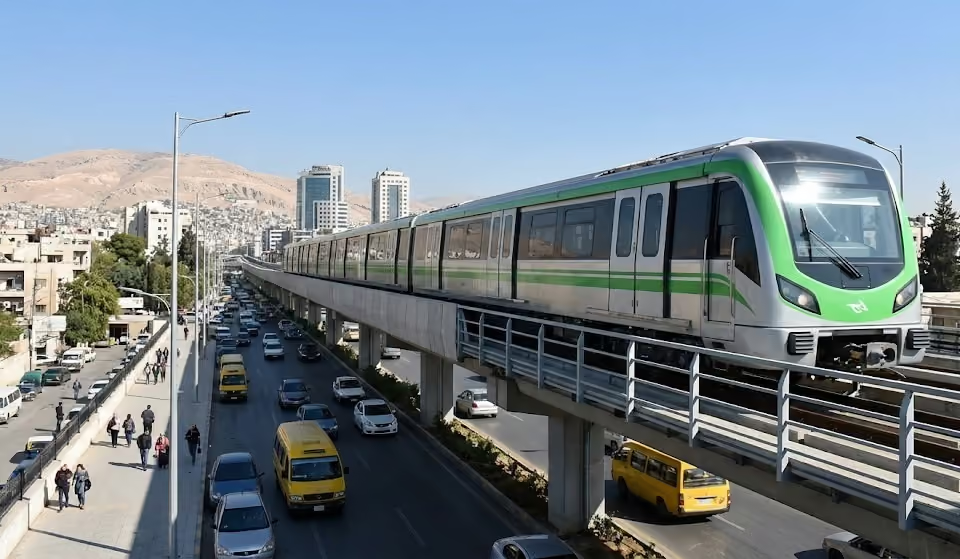
The Damascus Metro (Green Line) is planned as the backbone of the capital's future public transport system. It is intended to provide a fast, safe, and lower-emission transit option linking high-density residential areas with commercial and educational hubs, and to reduce traffic congestion.
- Route length: approximately 16.5 km.
- Stations: 17 stations (16 underground and 1 at surface level).
- Route path: starts from Al-Muadhamiya (Sumariya Interchange), passing through Mezzeh, Omayyad Square, Hijaz Station, and Abbasiyeen Square, and ending at Al-Qaboun.
The project is classified as an investment opportunity in the rebuilding phase. According to project documentation, it is expected to create jobs, reduce fuel consumption and carbon emissions, and affect the real estate value of surrounding areas.
Recent developments and investment (2025-2026)
The project has shifted from a government-funded model to an international investment model.
- Funding: recent Memorandums of Understanding (MoUs) involve investors from the United Arab Emirates and Saudi Arabia under the BOT (Build-Operate-Transfer) system.
- Modernization: the plan now includes "smart stations" equipped with solar energy panels, retail spaces, and digital ticketing systems.
- Integration: the metro is planned to integrate with a new fleet of electric buses and "Park & Ride" facilities at the city entrances (such as the Sumariya terminal).
Strategic impact
- Environmental: a reduction in carbon emissions by decreasing the number of micro-buses and private cars.
- Economic: job creation during construction and operation, and an effect on real estate value around station nodes.
- Urban renewal: the project includes the rehabilitation of streets and squares situated above the underground tracks.
Frequently Asked Questions
How long is the Damascus Metro Green Line?
The route is approximately 16.5 km long.
How many stations does the line have?
The line has 17 stations, 16 underground and 1 at surface level.
Which areas does the line connect?
It runs from Al-Muadhamiya (Sumariya Interchange) through Mezzeh, Omayyad Square, Hijaz Station, and Abbasiyeen Square, ending at Al-Qaboun.
How is the project funded?
Recent Memorandums of Understanding involve investors from the United Arab Emirates and Saudi Arabia under the BOT (Build-Operate-Transfer) system.
Update — 2025-08-06
The Damascus Metro was listed within a package of agreements announced on 6 August 2025 covering twelve projects in infrastructure, transport and real estate, presented by Syrian Investment Authority head Talal al-Hilali at a combined value of about USD 14 billion, as reported the same day by Al Jazeera and Middle East Monitor. Both outlets put the metro project at USD 2 billion with the UAE's National Investment Corporation.
According to SANA on the same date, the line serves 17 stations in districts including Mezzeh, Damascus University, Al-Hijaz, Tahrir Square, Abbasiyeen Square and the Pullman bus terminal in Qaboun, running from Muadamiyat al-Sham in the south-west of the capital to Qaboun in the north-east, and is expected to carry more than 750,000 passengers a day, among them some 250,000 visitors, 300,000 employees and 70,000 students.
Sources
Gallery :